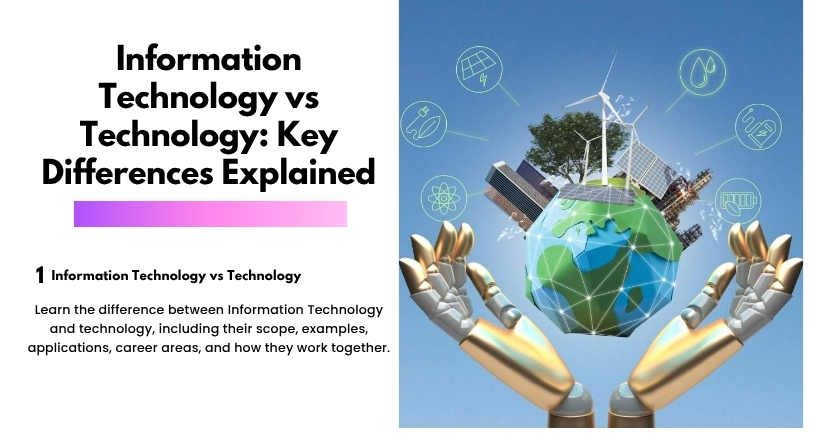
Information Technology and technology are closely related terms, but they do not have the same meaning. Technology is a broad concept that covers tools, systems, techniques, and processes created to solve problems or perform useful tasks. Information Technology (IT) represents a specific area of technology focused mainly on computing, information, data, software, and digital systems.
Understanding the difference helps avoid confusion when discussing technology careers, industries, products, infrastructure, and technical fields.
What Is Technology?
Technology refers broadly to the application of knowledge, tools, techniques, and systems to accomplish practical objectives. It includes everything from simple tools and mechanical systems to advanced computers, medical equipment, communication networks, industrial machines, and digital platforms.
Technology is therefore a very broad field. Computing and information systems represent only some of the many areas that fall within technology.
For a broader foundation, see What Is Technology?.
What Is Information Technology?
Information Technology refers to the use of computers, software, networks, databases, and related systems to create, process, store, protect, manage, and exchange information.
IT is commonly associated with activities such as software administration, network management, database management, cybersecurity, cloud computing, technical support, and enterprise systems.
For example, an organization’s IT department may manage employee computers, servers, networks, business applications, user accounts, databases, and security systems.
Technology vs Information Technology
The simplest distinction is scope.
Technology includes a wide range of technical fields and applications, while Information Technology focuses specifically on computing and information-related systems.
| Aspect | Technology | Information Technology |
|---|---|---|
| Meaning | Broad application of knowledge and tools | Technology focused on information and computing |
| Scope | Very broad | More specialized |
| Includes | Mechanical, electrical, digital, medical, industrial, and other technologies | Computers, software, networks, databases, cloud, and information systems |
| Main focus | Solving practical problems through technology | Managing and processing information |
| Examples | Robotics, medical devices, engines, smartphones | Servers, databases, software, networks |
| Common workplaces | Almost every industry | IT departments, software companies, data centers, technology services |
This difference becomes clearer when looking at the different Types of Technology and the specific areas that fall under the broader technology field.
Is Information Technology a Type of Technology?
Yes. Information Technology is a specialized area within the broader technology landscape.
Technology acts as the larger category, while IT represents one particular domain concerned with information processing and computing systems. Other areas can include medical technology, manufacturing technology, transportation technology, energy technology, communication technology, and agricultural technology.
The boundaries can sometimes overlap. For example, a smart factory may combine IT systems, industrial technology, communication networks, sensors, robotics, and automation within one environment.
Main Areas of Information Technology
Information Technology covers several specialized areas.
Computer Systems
IT professionals work with desktop computers, laptops, servers, operating systems, storage systems, and other computing resources.
Networks
Network technology connects computers, servers, applications, and users. IT teams may manage local networks, wireless networks, internet connections, routers, switches, and other networking equipment.
Software
Software allows computers and other digital systems to perform specific tasks. IT environments can include operating systems, business applications, databases, security software, and cloud applications.
Databases
Organizations use databases to store and manage structured information. IT professionals may configure, maintain, secure, and manage database systems.
Cloud Computing
Cloud computing provides computing resources, storage, applications, and other services through network-based infrastructure. Organizations can use cloud platforms instead of relying entirely on physical infrastructure within their own facilities.
Cybersecurity
Cybersecurity focuses on protecting systems, networks, applications, and information from unauthorized access, attacks, and other security threats.
Examples of Technology That Are Not Primarily IT
Not every technology belongs to Information Technology.
For example, a mechanical engine uses engineering principles to convert energy into motion. Medical imaging equipment uses electronics, computing, physics, and medical engineering. Industrial robots combine mechanical systems, electronics, sensors, control systems, and software.
These technologies can contain IT components, but their primary purpose may extend beyond managing information.
Similarly, electronic devices can support IT systems without being classified entirely as IT. This distinction becomes easier to understand when examining Electronic Technology Explained and its relationship with computing systems.
How Information Technology and Other Technologies Work Together
Modern systems rarely depend on a single technology. A business may use computers and databases to manage information while also relying on communication networks, electronic devices, cloud infrastructure, security systems, and physical equipment.
For example, an automated manufacturing facility may use industrial machines to produce goods, sensors to collect data, networks to transmit information, databases to store production records, and IT systems to analyze and manage that information.
This type of integration demonstrates how different technologies can operate as interconnected components within larger systems. Technology Systems Explained provides a broader look at how these components work together.
Information Technology vs Digital Technology
Information Technology and digital technology also overlap, but they are not identical.
Digital technology refers broadly to technologies that process information in digital form. Smartphones, digital cameras, digital payment systems, smart appliances, and digital media are examples.
Information Technology focuses more specifically on computing and information systems used to manage, process, store, secure, and communicate information.
A smartphone, for example, uses digital technology, but the IT infrastructure behind mobile applications, databases, cloud services, and network systems also supports many of its functions.
Information Technology vs Computer Science
Information Technology and Computer Science are related but have different areas of emphasis.
Computer Science focuses heavily on computing principles, algorithms, programming, computational theory, software development, and the design of computing systems.
Information Technology focuses more on applying computing systems to practical organizational and operational needs. IT can involve deploying, configuring, maintaining, securing, and supporting technology environments.
The two fields often overlap because IT professionals may use programming and computer science concepts, while computer science graduates may work on technologies used in IT environments.
Why the Difference Matters
Understanding the distinction between technology and Information Technology can help people describe industries, jobs, educational programs, and technical systems more accurately.
For example, saying that someone works in “technology” provides a broad description. They might work in software, electronics, robotics, telecommunications, manufacturing, cybersecurity, or another technical field. Saying that someone works in “Information Technology” identifies a more specific area centered on computing and information systems.
The distinction can also help students choose educational paths and understand job descriptions more clearly.
Career Areas in Information Technology
Information Technology includes many career paths, such as:
- IT support specialist
- Network administrator
- Systems administrator
- Database administrator
- Cloud engineer
- Cybersecurity specialist
- IT project manager
- Systems analyst
- IT consultant
- Infrastructure engineer
These roles can involve different combinations of hardware, software, networking, databases, cloud services, security, and organizational systems.
Technology and IT in Modern Organizations
Organizations increasingly depend on both broad technology and specialized IT systems. A company may use physical equipment, communication systems, electronic devices, software applications, cloud infrastructure, and data platforms as parts of one operational environment.
IT teams often help maintain the computing and information side of this environment, while other technical teams may manage engineering, manufacturing, electronics, telecommunications, or specialized equipment.
As technology continues to evolve, these boundaries can become less distinct because modern products increasingly combine software, hardware, connectivity, sensors, and data processing.
FAQ’s
Is Information Technology the same as technology?
No. Technology is a broad concept covering many technical fields, while Information Technology is a specialized area focused primarily on computers, information, software, networks, and related systems.
Is IT part of technology?
Yes. Information Technology is one specialized area within the broader technology field.
What is the main difference between IT and technology?
The main difference is scope. Technology covers a wide range of tools, systems, and technical applications, while IT focuses specifically on computing and information-related systems.
Is software part of Information Technology?
Yes. Software is an important part of IT because organizations use software to process information, operate systems, manage data, and provide digital services.