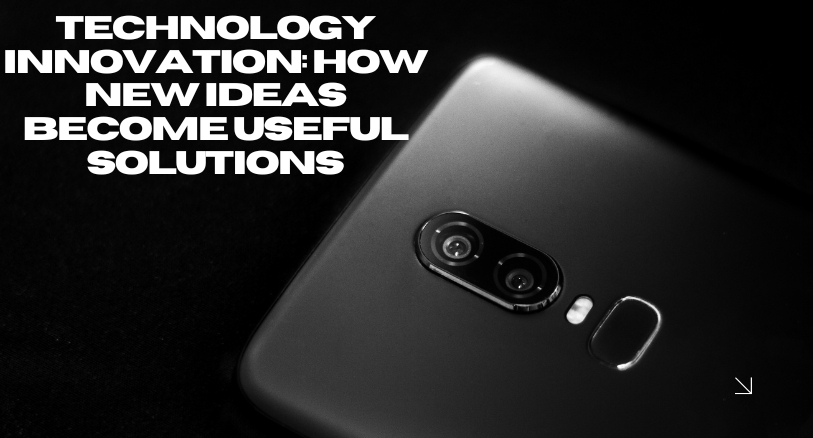
Technology innovation plays an important role in how new products, services, processes, and systems are developed. From smartphones and electric vehicles to cloud computing and automated machines, many technologies began as ideas that were later transformed into practical solutions.
But having a new idea does not automatically make something an innovation. Technology innovation involves identifying a problem or opportunity, developing an idea, testing it, improving it, and creating a solution that provides real value.
What Is Technology Innovation?
Technology innovation is the process of using new or improved technological ideas to create useful products, services, processes, or solutions.
An innovation can involve creating something completely new or significantly improving something that already exists.
For example, smartphones did not simply introduce mobile phones. They combined communication, computing, cameras, internet access, applications, navigation, and other capabilities into a single device.
Technology innovation can therefore involve:
- New technologies
- Improved products
- Better processes
- New digital services
- More efficient systems
- New ways of solving existing problems
Technology innovation is closely connected to What Is Technology?, because technology provides the tools and systems through which innovative ideas can become practical solutions.
How Does Technology Innovation Work?
Technology innovation usually develops through several stages.
1. Identifying a Problem
Many innovations begin with a problem.
A person, business, researcher, or organization identifies something that is inefficient, expensive, difficult, slow, or inconvenient.
For example, long waiting times for certain services can create an opportunity to develop a faster digital solution.
The problem provides the reason for creating something better.
2. Generating Ideas
Once a problem is understood, potential solutions can be developed.
Ideas may come from:
- Research
- Customer feedback
- Scientific discoveries
- Workplace challenges
- Market changes
- Existing technologies
- Observing everyday problems
At this stage, an idea does not have to be perfect. The objective is to explore different ways of solving the problem.
3. Evaluating the Idea
Not every idea is worth developing.
An idea may be evaluated based on:
- Usefulness
- Technical feasibility
- Cost
- Demand
- Available resources
- Potential benefits
- Risks
This stage helps determine whether an idea can realistically become a useful solution.
4. Developing a Prototype
A prototype is an early version of a product, system, or solution.
It allows developers to test how an idea works in practice.
A prototype does not necessarily need to be complete. Its purpose is to demonstrate important functions and identify problems before large-scale development.
For software, this might be an early version of an application.
For hardware, it might be a physical model that demonstrates the core functionality.
5. Testing the Solution
Testing helps determine whether the solution actually solves the original problem.
Developers may test:
- Performance
- Reliability
- Usability
- Security
- Efficiency
- Compatibility
- Safety
Testing can reveal problems that were not visible during the initial design stage.
6. Improving the Technology
Innovation is often an iterative process.
Developers use testing results and user feedback to make improvements.
A product may go through multiple versions before it becomes suitable for widespread use.
This is why many successful technologies continue to receive updates and improvements after their initial release.
7. Launching and Scaling
Once a solution is sufficiently developed and tested, it can be introduced to users.
If people find it useful, organizations may scale production or expand the service.
Scaling can involve:
- Increasing production
- Expanding infrastructure
- Supporting more users
- Entering new markets
- Improving distribution
- Automating operations
At this stage, the innovation moves beyond experimentation and becomes a practical technology solution.
Technology Innovation vs Invention
Technology innovation and invention are related but not identical.
An invention is the creation of something new.
An innovation generally involves applying a new or improved idea in a way that creates practical value.
For example, creating a new technical mechanism may be an invention. Turning that mechanism into a useful product that solves a real-world problem can involve innovation.
An innovation can also improve an existing technology rather than creating something entirely new.
Types of Technology Innovation
Technology innovation can take several forms.
Product Innovation
Product innovation involves creating a new product or significantly improving an existing one.
Examples include:
- Smartphones
- Electric vehicles
- Smart appliances
- Wearable devices
Process Innovation
Process innovation improves how something is produced or delivered.
For example, automation can reduce the time and resources required to manufacture a product.
Service Innovation
Service innovation uses technology to provide services in new or improved ways.
Examples include:
- Online banking
- Digital payment services
- Telemedicine platforms
- Online education
Business Model Innovation
Technology can also enable organizations to develop new ways of creating and delivering value.
Cloud software subscriptions are one example of how technology can support a different business model from traditional software sales.
Examples of Technology Innovation
Smartphones
The smartphone represents a major example of technological innovation because it combines multiple functions in one connected device.
A single smartphone can provide:
- Communication
- Internet access
- Navigation
- Photography
- Video
- Entertainment
- Mobile applications
- Digital payments
Its usefulness comes from integrating multiple technologies into one system.
Electric Vehicles
Electric vehicles use battery-powered electric motors instead of conventional internal-combustion engines.
Innovation in batteries, charging infrastructure, software, and vehicle design has helped improve their practicality.
Cloud Computing
Cloud computing changed how organizations access computing resources.
Instead of maintaining all computing infrastructure locally, organizations can access computing, storage, databases, and other services through remote infrastructure.
This innovation has influenced how software and digital services are developed and delivered.
Artificial Intelligence
Artificial intelligence enables computers to perform tasks involving capabilities such as pattern recognition, prediction, language processing, and decision-making.
AI-based technologies are being incorporated into applications across many industries.
Why Is Technology Innovation Important?
Technology innovation can create significant benefits for individuals, businesses, and society.
Improves Efficiency
New technologies can reduce the time, effort, and resources required to complete tasks.
Solves Problems
Innovation can provide new solutions to problems that existing methods cannot address effectively.
Creates New Products and Services
Technological innovation can create entirely new markets and services.
Supports Economic Growth
Successful innovations can create businesses, jobs, investment opportunities, and new industries.
Improves User Experiences
Technology can make products and services faster, easier, more accessible, or more convenient.
Encourages Competition
Innovation can encourage organizations to improve their products and processes to remain competitive.
Challenges of Technology Innovation
Innovation also involves challenges.
High Development Costs
Research, development, testing, infrastructure, and skilled employees can require significant investment.
Technical Uncertainty
An idea that looks promising may not work effectively when implemented.
Market Uncertainty
Even technically successful products may fail if users do not need or want them.
Security and Privacy
New digital technologies can introduce cybersecurity and data-protection risks.
Ethical Concerns
Some technologies can create ethical questions involving privacy, employment, decision-making, or the responsible use of data.
Resistance to Change
People and organizations may be reluctant to adopt new technologies when existing systems are familiar.
The Role of Research in Technology Innovation
Research provides the knowledge needed to develop new technological solutions.
Scientific research can uncover new materials, methods, algorithms, and processes.
Businesses can also conduct market research to understand customer needs and identify opportunities for improvement.
Research therefore helps connect knowledge with practical technological applications.
The Role of Users in Innovation
Technology innovation is not only driven by developers.
Users can play an important role by providing feedback about:
- Problems
- Usability
- Missing features
- Performance
- Convenience
- Real-world requirements
A technically advanced product may not succeed if it does not solve a meaningful user problem.
User feedback helps organizations refine technology and make it more useful.
How Technology Innovation Shapes the Future
Technology innovation continues to influence how people live and work.
Emerging developments in areas such as artificial intelligence, robotics, biotechnology, renewable energy, advanced computing, and connected systems may create new solutions for existing and future challenges.
However, future innovation will depend not only on technological capability but also on factors such as affordability, accessibility, safety, sustainability, regulation, and public acceptance.
The impact of innovation therefore depends on how effectively technology is developed and applied in the real world.
FAQ’S
What is technology innovation?
Technology innovation is the development or improvement of technological products, services, processes, or systems to create practical value or solve problems.
How does an idea become a technology innovation?
An idea can become an innovation by identifying a real problem, developing a solution, creating and testing prototypes, improving the technology, and eventually applying it in the real world.
What is the difference between invention and innovation?
An invention involves creating something new, while innovation generally focuses on applying new or improved ideas in ways that provide practical value.
What are examples of technology innovation?
Examples include smartphones, electric vehicles, cloud computing, digital payment systems, artificial intelligence applications, and automated manufacturing systems.
Why is technology innovation important?
Technology innovation can improve efficiency, solve problems, create new products and services, support economic growth, and improve how people interact with technology.
Can an improvement to an existing technology be an innovation?
Yes. Innovation does not always require creating something completely new. Significant improvements to existing products, processes, or systems can also be technological innovations.
Conclusion
Technology innovation is the process of turning ideas into useful technological solutions. It often begins with identifying a problem and continues through idea development, evaluation, prototyping, testing, improvement, and implementation.
Innovation can create new products and services while also improving existing technologies and processes. Its success ultimately depends on whether it provides meaningful value and solves a real problem.
As technology continues to develop, innovation will remain an important driver of new solutions and technological progress.