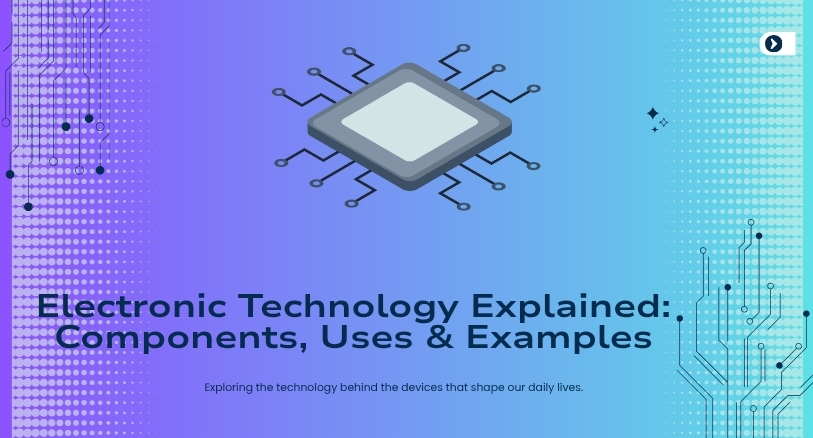
Electronic technology forms the foundation of many devices and systems used in modern life. Smartphones, computers, televisions, medical equipment, communication devices, industrial machines, and countless other products depend on electronic components to process, control, store, and transmit electrical signals.
Unlike mechanical systems that primarily depend on physical movement, electronic systems use components such as semiconductors, resistors, capacitors, integrated circuits, sensors, and microcontrollers to control the flow of electrical signals. Understanding these components makes it easier to understand how modern electronic devices function.
What Is Electronic Technology?
Electronic technology refers to the use of electronic circuits, components, and systems to control, process, store, transmit, or transform electrical signals and information. It covers technologies ranging from simple circuits to highly complex computing and communication systems.
Electronic technology often combines hardware components with software and control systems. For example, a smartphone contains processors, memory, sensors, communication circuits, a display, and software that work together as an integrated electronic system.
For a broader introduction to the field, see What Is Technology?.
How Does Electronic Technology Work?
Electronic technology works by controlling electrical signals through interconnected components. These components perform specific functions such as regulating voltage, storing electrical energy, switching signals, detecting physical conditions, or processing information.
A basic electronic system may receive an input from a sensor or user, process that signal through one or more circuits, and produce an output. For example, when a user presses a button on an electronic device, a circuit can detect the input, process it, and instruct another component to perform an action.
Modern electronic systems can contain thousands, millions, or even billions of components. Engineers combine these components into circuits and integrated systems designed for specific applications.
Main Components of Electronic Technology
Electronic systems rely on different components, with each component performing a particular function.
Resistors
A resistor limits or controls the flow of electrical current within a circuit. Engineers use resistors to manage voltage levels, protect components, and establish specific electrical conditions.
Capacitors
Capacitors store and release electrical energy. They commonly help stabilize power supplies, filter signals, remove unwanted fluctuations, and support timing functions in electronic circuits.
Inductors
Inductors store energy in a magnetic field when electrical current flows through them. They appear in applications such as power supplies, filters, radio-frequency circuits, and communication equipment.
Diodes
A diode allows electrical current to flow primarily in one direction. Engineers use diodes for rectification, signal protection, voltage regulation, and switching applications.
Transistors
Transistors act as electronic switches or amplifiers. They form the basis of modern digital circuits and play a central role in processors, memory devices, communication equipment, and many other electronic systems.
Integrated Circuits
An integrated circuit, or IC, combines many electronic components into a small semiconductor device. Microprocessors, memory chips, communication chips, and controllers are common examples of integrated circuits.
Sensors
Sensors detect physical conditions such as temperature, light, pressure, motion, humidity, or sound and convert those conditions into electrical signals that an electronic system can process.
Microcontrollers
A microcontroller combines a processor, memory, and input/output functions into a compact integrated circuit. Engineers use microcontrollers in appliances, automobiles, industrial equipment, IoT devices, and embedded systems.
Types of Electronic Technology
Electronic technology covers several major areas, depending on the function and application of the system.
| Type | Examples | Common Applications |
|---|---|---|
| Consumer electronics | TVs, cameras, speakers | Home entertainment and personal use |
| Computing electronics | CPUs, memory, motherboards | Computers and servers |
| Communication electronics | Radios, routers, wireless modules | Data and voice communication |
| Industrial electronics | Controllers, drives, monitoring systems | Manufacturing and automation |
| Medical electronics | Monitoring devices, imaging equipment | Healthcare |
| Automotive electronics | Sensors, control units, infotainment | Vehicles |
| Power electronics | Converters, inverters, controllers | Power management |
| Embedded electronics | Microcontrollers, sensors | Appliances and smart devices |
These categories can overlap because one product may contain several types of electronic technology. This broader relationship between components and functions is also important when studying Technology Systems Explained.
Examples of Electronic Technology
Electronic technology appears in products and systems across almost every major industry.
Smartphones
Smartphones combine processors, memory, sensors, displays, cameras, batteries, wireless communication circuits, and other electronic components. These components allow a single device to perform communication, computing, photography, navigation, entertainment, and many other functions.
Computers
Computers use processors, memory, storage controllers, graphics processors, power circuits, and communication hardware to process and exchange digital information.
Televisions
Modern televisions use electronic circuits to process digital signals, control displays, manage audio, connect to networks, and run applications.
Medical Devices
Electronic technology supports devices such as patient monitors, digital thermometers, diagnostic equipment, imaging systems, and wearable health-monitoring devices.
Automotive Systems
Modern vehicles contain electronic control units, sensors, cameras, displays, navigation systems, communication modules, and safety systems. These components help vehicles monitor conditions and control various functions.
Industrial Equipment
Factories use electronic controllers, sensors, motors, measurement systems, and automation equipment to monitor and control production processes.
Uses of Electronic Technology
Electronic technology supports a wide range of activities in everyday life and industry.
Communication
Electronic circuits allow devices to transmit and receive information through wired and wireless communication systems. Smartphones, radios, routers, televisions, and satellite communication equipment all depend on electronic technology.
Computing
Processors and memory systems use electronic circuits to perform calculations and process digital information. This makes electronic technology fundamental to computers, servers, smartphones, and other computing devices.
Automation
Electronic controllers and sensors allow machines to respond automatically to changing conditions. Automation appears in manufacturing, smart homes, vehicles, appliances, and industrial systems.
Measurement and Monitoring
Sensors allow electronic systems to detect physical conditions and convert them into usable information. Monitoring systems can measure temperature, pressure, movement, light, humidity, and many other variables.
Entertainment
Televisions, gaming consoles, digital cameras, speakers, headphones, and streaming devices rely on electronic components to process and reproduce digital content.
Transportation
Electronic systems support navigation, engine management, vehicle safety, communication, traffic control, and monitoring systems across modern transportation networks.
Electronic Technology in Everyday Life
People interact with electronic technology from the moment they use a smartphone or switch on a television. Electronic components operate inside devices even when users never directly see them.
A smart speaker, for example, can use microphones to capture sound, processors to interpret information, wireless circuits to communicate with online services, and speakers to produce an audio response. Similarly, a washing machine can use sensors, a microcontroller, switches, and a display to control different stages of a washing cycle.
Electronic Technology vs Electrical Technology
Electronic technology and electrical technology are closely related, but they generally focus on different functions.
Electrical technology primarily deals with the generation, distribution, transmission, and use of electrical power. Electronic technology focuses more heavily on controlling electrical signals and processing information using electronic components.
| Electrical Technology | Electronic Technology |
|---|---|
| Focuses heavily on electrical power | Focuses heavily on signals and information |
| Uses generators, transformers, motors, and power systems | Uses transistors, ICs, sensors, and microcontrollers |
| Common in power distribution and electrical machinery | Common in computers, communication, and control systems |
| Often handles higher power levels | Often handles lower signal and control levels |
The two fields frequently work together. An electronic controller may manage an electrical motor, while an electrical power system may provide the energy required by electronic equipment.
Advantages of Electronic Technology
Electronic technology provides several important benefits. Miniaturized components allow manufacturers to build powerful systems into increasingly small devices, while digital processing enables fast and repeatable operations.
Other advantages include:
- High processing speed
- Compact device design
- Precise control
- Automation capabilities
- Efficient signal processing
- Reliable data handling
- Integration of multiple functions
- Support for wireless communication
These characteristics have contributed to the broader development and Evolution of Technology, particularly as electronic components have become smaller, faster, and more capable.
Limitations and Challenges
Electronic technology also creates technical and practical challenges. Electronic’s components can fail because of excessive heat, electrical surges, physical damage, manufacturing defects, or environmental conditions.
Electronic waste represents another important concern. Devices eventually reach the end of their useful life, and improper disposal can create environmental problems. Manufacturers and consumers therefore need to consider repairability, recycling, component reuse, and responsible disposal.
Security also matters when electronic devices connect to networks. Connected devices can create cybersecurity risks if manufacturers do not implement appropriate protections.
Future of Electronic Technology
Electronic technology continues to develop through advances in semiconductor manufacturing, integrated circuits, sensors, processors, wireless communication, and energy-efficient components.
Smaller and more capable chips are enabling increasingly powerful devices, while sensors and embedded controllers are expanding the number of physical objects that can interact with digital systems. These developments support applications such as connected devices, robotics, industrial automation, smart transportation, and advanced computing.
As electronic components become more integrated, individual devices increasingly function as parts of larger interconnected systems rather than operating independently.
FAQ’s
What is electronic technology?
Electronic technology uses electronic components and circuits to control, process, store, transmit, or transform electrical signals and information.
What are the main components of electronic technology?
Common components include resistors, capacitors, inductors, diodes, transistors, integrated circuits, sensors, and microcontrollers.
What are examples of electronic technology?
Examples include smartphones, computers, televisions, medical equipment, automotive control systems, industrial controllers, cameras, and communication devices.
What is the difference between electrical and electronic technology?
Electrical technology focuses heavily on generating, distributing, and using electrical power, while electronic technology focuses more on controlling electrical signals and processing information.